
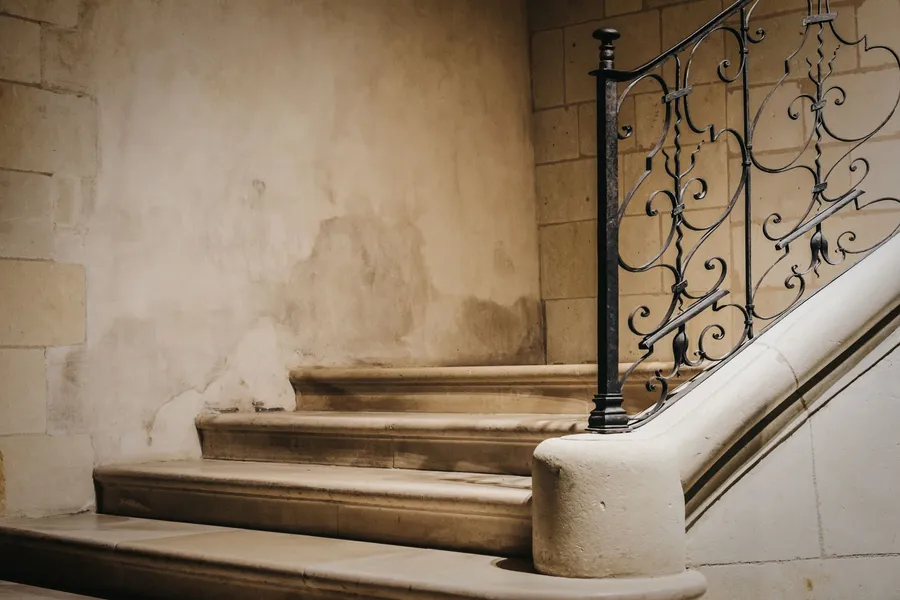
A voluntary standard, a separate legal basis
A frequently misunderstood point: the NF P01-012 standard itself isn't a direct legal obligation. It's a voluntary AFNOR standard. The real legal basis is French building regulations (Code de la Construction et de l'Habitation, articles R.111-15 and R.134-59) — the standard technically details these requirements, which makes it in practice the reference professionals follow. In effect, complying with it means following the spirit of the law, even though the standard itself isn't strictly binding.
Height: the stair nosing as reference
For a staircase, the guardrail's height is measured from the stair nosing — the front edge of each step — not from the finished floor. Commonly used benchmarks sit between 0.80m and 1m; some configurations use a flat 0.90m. This reference differs from a balcony guardrail, measured from the finished floor — see our standards and safety page for the full comparison.

Spacing: the anti-climb zone logic
Maximum spacing between infill elements isn't uniform across the full height of a horizontal-rail guardrail: within the first 45cm (the "anti-climb zone", designed to stop a young child from climbing), spacing must stay under 11cm. Above that zone, it can go up to 18cm. For vertical balusters, however, the rule is uniform: 11cm maximum over the full height, with no zone distinction.

The threshold that triggers the requirement
A stair guardrail becomes mandatory once the fall height exceeds 1m or the slope exceeds 45°. A low indoor staircase (just a few steps, no significant drop to the side) may, depending on its exact configuration, not be affected — a point to assess case by case rather than assume a universal rule.
Why these figures, not others
The 11cm and 45cm thresholds aren't arbitrary: they correspond to gauges designed to stop a young child's body or head from passing through, and to limit the possibility of climbing the infill like a ladder. It's this child-safety logic, more than aesthetics, that explains why the low zone (0 to 45cm) is treated more strictly than the rest of the structure.
Frequently asked questions
Is the NF P01-012 standard the same for every staircase?
The principles (height from the nosing, spacing by zone) apply generally, but the exact configuration (staircase type, building use) can affect certain points — to check case by case, ideally at the quote stage.
Does an old non-compliant staircase need to be brought up to standard?
Bringing it up to standard isn't systematically mandatory for an existing structure, but it's strongly recommended for safety, and becomes relevant as soon as the staircase is altered, renovated, or a guardrail is replaced.
Does the standard also apply to outdoor staircases?
Yes, the same height and spacing principles apply, plus a corrosion-protection requirement (galvanizing) specific to outdoor exposure — see our balcony and terrace guardrail page.